
Chris & Mac
We outventure to help you outventure!
For us, outventuring isn’t just about adventure. It’s about the quiet moments — the first light on a ridgeline, the sound of a creek at camp, the shared laughter when the trail gets spicy. We believe the outdoors enriches people’s lives, and we want to help more folks experience that connection. Learn more about us HERE.
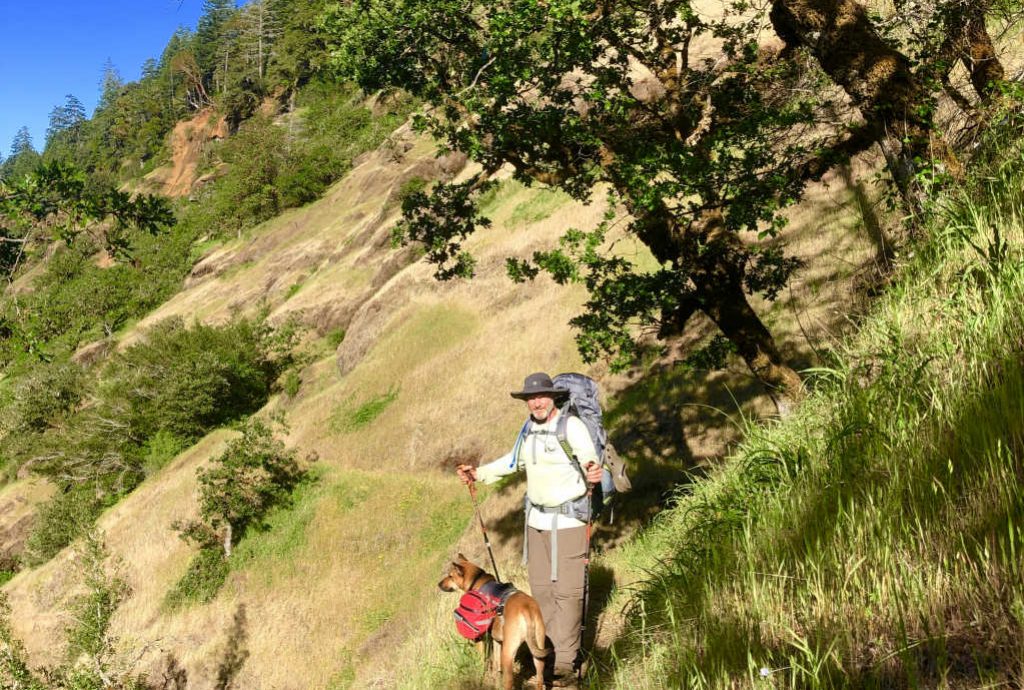
Backpacks: Osprey EJA 58 for Mac and the Osprey EXOS 58 for Chris are the models we currently carry. Inside, these packs hold tents, poles, chairs, food, clothes, sleep pad, sleeping bag, pillow, cook system, and more. Outside stretch pockets fit everything else. You will see pictures in our backpacking articles of earlier packs – also Osprey. All of these packs have performed well and carried comfortably. After testing a few models over many backcountry trips, we find the EJA 58 and the EXOS 58 are the perfect fit.
Trekking Poles: We use trekking poles on all our backpacking trips. They take pressure off knees and backs, which is particularly important on difficult and longer hikes. They are also great for stream crossings and tough terrain. Our preferred brand for poles is LEKI. Currently, Chris uses the LEKI Black Series Carbonand Mac uses the LEKI Women’s Cressida AS Pole.
Water Bladder: We both use Platypus water bladders. Osprey backpacks, although designed to carry a water bladder, do not come with one. We think the best, most stable, and easy to use bladders are those made by Platypus. They come in a variety of sizes. We both carry the three liter size, filling them as necessary based on the day’s planned hike.
Bottle for Hydration Mix: In addition to water, both Chris and Mac carry a separate bottle with a hydration packet added to replace electrolytes lost through sweat. Hands down, we believe the best bottles for this are made by Platypus. They weigh virtually nothing and are amazingly durable.
Tent & Tent Footprint: Tents bring with them a lot of weight – that is why we stick with ultralight tents. Additionally, we have found it is easier to find level ground, and we are both more comfotable, using separate tents.
The NEMO Hornet Elite OSMO™ Ultralight Backpacking Tent is the newest key part of our equipment. We chose their two person tents for greater interior width, double outside vestibules, and ability to pack these tents in multiple ways. They are incredibly lightweight – pack weight of 2.1 lbs – even when adding the Hornet OSMO Footprint designed to fit the model.
Previously, we were using the Big Agnes Copper Spur HV UL1(one person). They are hard to beat and we do recommend them – but not in moist areas. Condensation issues are the only downside to these tents. Add the Big Agnes Copper Spur HV UL Series One Person Footprint designed to fit this model.
Sleeping Bags: A quality, lightweight sleeping bag for backpacking is pretty darn important. For both quality and weight, we love Western Mountaineering bags. They are extremely well constructed, amazingly light weight, warrant temperature rating given, and stuff to an incredibly small size. For colder climates, we use the Western Mountaineering TerraLite: Down 25 Degree Bag, while for warmer trips we use the Western Mountaineering Everlite: Down 45 Degree Bag. If conditions will be freezing and below, The Western Mountaineering Versalite Bag: 10 Degree Bag is our go to. Trust us, these bags do not disappoint.
Pillows: We both use the NEMO Equipment Fillo Elite Ultralight Backpacking Pillow and we love them. They have comfortable fabric tops, are inflatable to desired firmness, stuff into their own attached stuff sack, pack down super small – and weigh only 3 ounces.
Sleeping Pads: To us, a quality sleeping pad is a must for a good night’s sleep on the trail. We each have three sleeping pads. The higher the insulation rating, the more insulation from cold it provides, however the pad becomes heavier and bulkier. As with our other gear, we take the pad best suited to whatever conditions we expect to encounter. From hot to mildly cold to totally frigid conditions, we outfit with the following inflatable pads.
For hot weather, there is no need to carry additional weight for an insulated pad, so we use the NEMO Astro Lite Sleeping Pad. It is light, very small to pack, and provides an excellent night’s sleep.
When we need protection from colder temperatures, we turn to NEMO’s Tensor™ line of lightweight, insulated pads. Our most often used pad, the NEMO Tensor™ Trail Ultralight Insulated Sleeping Pad covers a wide range of mild to moderately cold summertime temperatures in mountainous areas. If the overnight conditions we are heading into will be freezing and below, we pack the NEMO Tensor™ Extreme Condition Ultralight Insulated Sleeping Pad for maximum protection from the cold.
Cook Stove: For us, backpacking is not about the food. We love to cook and eat well at home, but preparing meals on the trail comes with a significant weight penalty. As such, we carry lightweight dehydrated food and a water boiling system. For boiling, we bring along our Snow Peak GigaPower Lite Max and Snow Peak Titanium Trek 1400 Cook Set. This system weighs in at a mere 9.8 oz and takes little space because we store our fuel canisters inside the cook set. For light weight backpacking, it is a great way to go.
Cooking & Eating: Because we rehydrate our food with boiling water, we have no need of bulky pots and pans. To keep things simple and light, we use the MYBAND Insulated Pouch Backpacking Food Cozy. Amazon carries them. Since we pre-package all of our dehydrated foods in ziplock freezer bags, we simply slip them into the cozy, open, add hot water, zip closed (remove excess air), and and let them steep. As a bonus, when it is cold, tuck it in your jacket (not next to skin!)… luxurious warmth! For a drinking mug, we use the Sea to Summit X-Mug Collapsible Mug, however it is no longer widely available. The new version, the Sea to Summit Frontier UL Collapsible Cup collapses to wafer thin and weighs 1.9 oz. Finally, for an eating utensil we use the incredibly light Snow Peak Titanium Spork. That’s it! The three together are very light weight – spork and cup stow perfectly inside the cozy when not in use.
Food Storage: Food protection is important not only when dealing with bears, but also rodents. When hard sided bear protection is required, we like the Bearvault BV 450 Bear Resistant Food Canister. It is substantially lighter than most hard sided bear containers and fits comfortably in a backpack, while holding enough food and toiletries for up to a five night backpacking trip. It also makes a reasonable seat for camp and the lid works well as a work surface out of the dirt. When hard sided bear protection is not required, we also use the Ursack Allmitey Bear and Critter Sack. This soft-sided bear and rodent protection is approved for most areas requiring bear food protection, saves almost one pound over the Bearvault 450, can be hung from a tree or tied to it, and holds more than enough food and toiletries for up to a five night backpacking trip.
Water Filtration: For backpacking, a water filtration system is a must. Our go to is the Platypus QuickDraw Filter. It weighs almost nothing and is incredibly simple to use.
Chairs: Let’s face it, sitting on the ground, a bear vault, or a log is not exactly comfortable. In many instances, we will take the weight penalty to carry a camp chair to increase our comfort. Our go to is the Helinox Chair Zero. It weighs only 1.1 lbs and packs down to a very small size. The chair is amazing. Other chairs we have used are the Helinox Chair One (2lbs 2oz) and the Helinox Sunset Chair (3 lbs, 7 oz). With these larger chairs you do get more comfort, but the penalty is weight and less room in your pack. That said, they are fantastic chairs.
Ultralight Jackets and Pants: A warm jacket is a must for most backpacking trips, but they can be heavy and bulky. Same is true for warm pants. Since we typically only use them in camp when it gets cold, finding the right pieces can be a challenge.
Mac gets cold in camp – especially her lower half. Rain pants and jackets provide her some insulation, but are not adequate when it is downright chilly. Finding the right jacket and pants to keep both of us warm on cold evenings and mornings was imperative. Enter Enlightened Equipment. We purchased their Torrid Pullover and Torrid Pants and are delighted with them. These synthetic pieces are super lightweight and comfortable. They crush and stuff into our packs beautifully, and they 100% keep us warm! We can’t say enough good things about these pieces from Enlightened Equipment. Mac absolutely loves her Torrids. Game changer pieces for sure.
When temperatures are cool, but not cold enough for our Torrids, we stuff our Mountain Hardwear Ghost Whisperer down jackets in our packs. They squish to almost nothing and are super lightweight.
Hiking Shoes: Hiking shoe technology is changing rapidly and we go through a lot of shoes. Currently, Chris wears the Salomon Men’s Quest 4 GOR-TEXand Mac wears the women’s Solomon Women’s Quest 4 GOR-TEX. These boots are great right out of the box! Not only do they have excellent traction on mixed terrain, but their waterproof/breathable membranes keep our feet dry in wet weather – and during water crossings where the depth does not exceed the tops of the boot. Additionally, these boots deliver outstanding ankle and heel support that are particularly important on tough terrain and long hikes. We are both very happy with the performance of our shoes.

Headlamps: Headlamps are a must for backpacking. Chris carries the Chris carries the Black Diamond Spot 400 Headlamp and Mac carries the Petzl ACTIK Headlamp. Both are light weight, powerful, and have a variety of beams as well as red light so you won’t disturb your neighbors.
Multi-Tool: Equipment does occasionally break while on the trail. Carrying a multi-tool, as well as some tie wraps and a strong tape such as Tenacious Tape, can be instrumental in solving the problem. For backpacking, We both carry the ultra light Gerber Dime Mini Multi-Tool. Despite its small size and limited number of tools, it has the basic tools needed to fix most problems.
Ditty Bags: Ditty bags are a great way to organize gear in your pack. We carry the Granite Gear Tough Sack 2L and 5L for backpacking. The 2L size has enough room to store first aid, a multi-tool, a battery back-up, tie-wraps and some tape. The 5L bag is large enough to carry the extra clothes we need for up to a 5 night backpacking trip. The bags come in a variety of sizes, are ultralight, and coated for water resistance.
Pack Cover: We use the Osprey Ultralight Backpack Rain Cover. They are very lightweight and available in a variety of sizes to fit your backpack.
Day Pack (When Warranted): We occasionally carry an ultralight day pack when we intend to leave the backpacking site set-up for a second night so we can do side ventures. At 2.4 oz and a packed size that fits in the palm of your hand, it is impossible to beat the minimalist Sea to Summit Ultra-Sil Day Pack for this purpose.